

THE BUYER'S GUIDE / SELECTION
Choosing a Bedding Set Fabric: Material, Fit and Intended Use
Selecting the right bedding set fabric involves more than picking a colour or pattern. Buyers need to weigh fibre content, weave structure, thread count, fabric width, shrinkage tolerance and the end use environment — whether that is a luxury hotel, a hospital ward or a home bedroom. This guide walks procurement teams and brands through the key criteria, supported by confirmed fabric specifications from Hebei Henghe Bangxing New Material Co., Ltd., so that sourcing decisions are grounded in verifiable product details rather than guesswork.

Fibre content and blend rationale: choose between 100% cotton, CVC 50/50, or multi-fibre blends (Tencel, Modal, Bamboo, Wool/Cotton) based on laundering environment, softness requirements and market positioning.
Weave structure and surface character: satin weave delivers a smooth, lustrous finish suited to hospitality; dobby weave provides structural geometric texture suited to differentiated home and luxury lines.
Fabric width and cutting efficiency: wider widths (300 cm or 110 inches) reduce seam count and improve yield for large bedding items such as duvet covers and flat sheets.
Thread count, density and weight: TC should be evaluated alongside yarn count and weave; confirmed range covers 200TC to 1500TC for dobby and 145×95 density at 150 g/m² for CVC satin-stripe.
Shrinkage tolerance and washing performance: the confirmed CVC 50/50 satin-stripe fabric declares a 3%–5% shrinkage rate, which must be factored into cutting patterns and end-use expectations.
Customisation scope and minimum order quantities: custom colours are available from 3,000 m per colour for the CVC satin-stripe fabric; dobby specifications are adjustable to customer requirements.
Why Fabric Choice Defines the Bedding Set
A bedding set is only as good as the fabric it is made from. Thread count figures and brand names can be misleading; what actually determines how a set performs over time is the combination of fibre, yarn construction, weave type and finishing. Whether you are equipping a hotel chain, supplying a hospital, or building a private-label home-textile brand for the US, European or Middle Eastern market, aligning fabric specifications to end-use requirements is the most reliable path to satisfied end customers and fewer returns.
Hebei Henghe Bangxing New Material Co., Ltd. manufactures a range of bedding set fabrics — from CVC satin-stripe cloth engineered for hospitality to wide-width dobby fabrics suited for large-format home and luxury applications. The sections below use confirmed product specifications to frame the decision criteria every buyer should apply.
Criterion 1 — Fibre Content and Blend Rationale
Fibre content is the single biggest driver of a fabric's feel, moisture management and long-term durability.
100% Cotton offers natural breathability, moisture absorption and a soft hand feel that improves with washing. The confirmed dobby bedding fabrics in the range include 100% cotton options built from compact yarn, which reduces pilling and gives a cleaner surface finish compared with standard ring-spun cotton. For buyers targeting luxury bedding sets or high-end home markets, cotton remains the benchmark fibre.
CVC (Chief Value Cotton) 50/50 blends combine cotton's comfort with polyester's dimensional stability and wrinkle resistance. The confirmed CVC 50/50 satin-stripe bedding set fabric is specifically positioned for hotel and hospital end uses — environments where commercial laundering at high temperatures is routine and fabric recovery after repeated washing is essential. The 50/50 ratio keeps the fabric comfortable while extending service life under institutional conditions.
Multi-fibre options in the dobby fabric range include Polyester/Cotton, Tencel, Modal, Bamboo and Wool/Cotton blends. Each fibre introduces a different performance profile:
- Tencel and Modal contribute a silky drape and enhanced moisture-wicking suited to premium consumer markets.
- Bamboo blends bring natural softness and are positioned toward eco-conscious segments.
- Wool/Cotton adds warmth and is relevant for winter-weight bedding in colder climates.
Buyers should confirm which blend aligns with their market's washing habits, regulatory requirements and positioning before placing an order.
Criterion 2 — Weave Structure and Surface Character
The weave determines how a fabric looks, how it wears and how it feels against the skin.
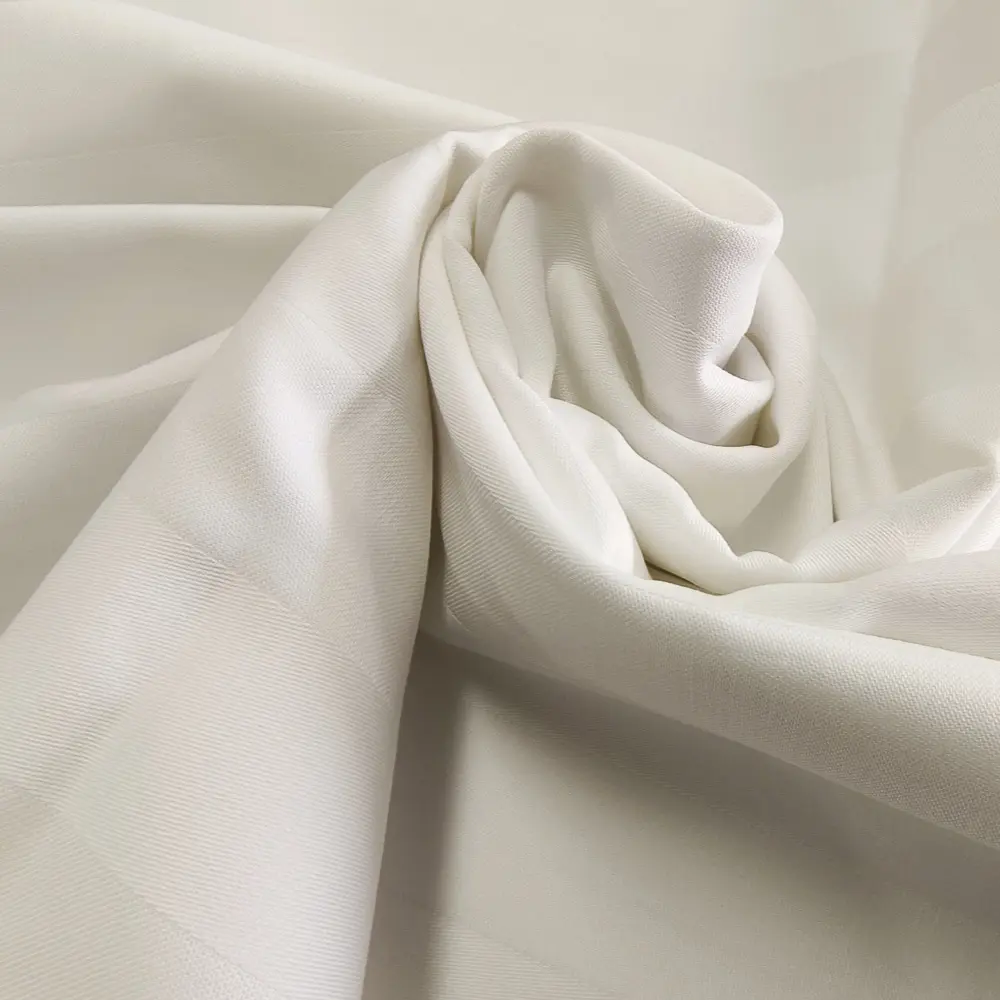
Satin weave produces a smooth, lustrous surface by floating yarns over multiple weft or warp threads before interlacing. The confirmed CVC 50/50 satin-stripe fabric (40×40 yarn count, 145×95 density) achieves this characteristic sheen and is widely used in hotel linen programmes where presentation matters alongside durability.
Dobby weave uses a dobby attachment on the loom to create geometric patterns and textured surfaces that a plain or satin weave cannot produce. The texture adds visual depth to the fabric without printing or embroidery, which means the design is structural rather than surface-applied and will not fade with washing. The confirmed dobby fabrics are available across a wide density range — 200TC through to 1500TC — allowing buyers to specify the weight and handle appropriate for their product tier.
For buyers building a differentiated product line, the combination of yarn style (ring-spun, siro-spun or compact yarn) and weave type provides a meaningful lever. Compact yarn reduces hairiness and surface fuzz, supporting a cleaner, crisper finish that is particularly valued in high thread count dobby bedding.
Criterion 3 — Fabric Width and Cutting Efficiency
Fabric width has a direct impact on production yield and cost, especially for large flat items such as duvet covers and fitted sheets.
The confirmed CVC satin-stripe bedding set fabric is offered at 110 inches (approximately 280 cm) width — sufficient to cut a standard king-size duvet cover from a single width without a centre seam, depending on finished dimensions.
The confirmed dobby bedding fabric range includes an extra-wide 300 cm width option designed specifically to improve cutting efficiency for double, king and super-king bedding sets. Eliminating centre seams reduces sewing time, improves aesthetics and lowers the risk of seam failure in use. Buyers producing large quantities of wide-format bedding should factor width into their cost models alongside price per metre.
The wider dobby fabric range also covers 160 cm to 340 cm, giving cut-and-sew operations flexibility to match their specific product dimensions without unnecessary fabric waste.
Criterion 4 — Thread Count, Density and Weight
Thread count (TC) is a frequently misused marketing figure, but density and weight remain meaningful technical parameters when used alongside yarn count and weave specification.
The confirmed CVC satin-stripe fabric carries a yarn count of 40×40 and a density of 145×95 (warp × weft threads per inch), with a fabric weight of 150 g/m². These figures indicate a mid-weight fabric appropriate for year-round institutional use — substantial enough for durability but not so heavy as to impede drying in commercial laundry operations.
The confirmed dobby fabric range spans 200TC to 1500TC, acknowledging that different market tiers have different expectations. Entry-level home products may be adequately served at 200–300TC; luxury and premium-branded lines are commonly positioned at 500TC and above. Buyers should treat TC as a relative indicator within a given fibre and weave category, not as a universal quality ranking across different fibres and constructions.
Criterion 5 — Shrinkage Tolerance and Washing Performance
Bedding is washed more frequently than most other home textiles. Shrinkage directly affects finished dimensions and consumer satisfaction, particularly for fitted sheets and pillow cases with tight tolerances.
The confirmed CVC 50/50 satin-stripe fabric states a shrinkage rate of 3%–5%. Buyers developing products in this fabric should incorporate this allowance into their cutting patterns and communicate expected post-wash dimensions to end customers or housekeeping procurement teams.
For institutional buyers (hotels, hospitals), the predictability of shrinkage is as important as its magnitude. A fabric that shrinks consistently within a declared range allows procurement teams to standardise linen inventories without needing to stock multiple size variants to compensate for variable shrinkage behaviour.
Criterion 6 — Customisation Scope and Minimum Order Quantities
Buyers building a private-label or branded bedding set programme need to understand what can be customised and at what minimum volume.
The confirmed CVC satin-stripe bedding set fabric supports custom-made colour with an MOQ of 3,000 metres per colour. This threshold is relevant for buyers evaluating whether a programme is commercially viable at their anticipated volume.
The confirmed dobby bedding fabric specifications state that all specifications can be supplied according to customers' requirements, which covers density, width, fibre blend and finish. This flexibility is valuable for buyers whose product briefs fall outside standard catalogue specifications — for instance, a specific TC requirement for a licensed brand or a particular fibre blend for a regional climate.
End-Use Matching: Applying the Criteria
| End Use | Recommended Fibre | Weave | Width Consideration | Key Parameter |
|---|---|---|---|---|
| Hotel linen programme | CVC 50/50 | Satin stripe | 110" sufficient for standard sizes | Shrinkage 3%–5%; institutional wash durability |
| Hospital / healthcare | CVC 50/50 | Satin or plain | Depends on finished size spec | Shrinkage 3%–5%; confirm wash-chemistry compatibility with supplier |
| Luxury home consumer | 100% Cotton or Tencel/Modal blend | Dobby | 300 cm for seam-free wide cuts | High TC (500+); compact or siro yarn |
| Mid-range home market | 100% Cotton or Poly/Cotton | Dobby | 160–300 cm | 200–400TC; competitive yield from wide width |
| Eco or sustainable line | Bamboo blend | Dobby | As required | Fibre certification requirements — confirm with supplier |
Table is a selection guide derived from confirmed product descriptions. Certification, pricing and delivery terms require direct confirmation with Hebei Henghe Bangxing New Material Co., Ltd.
Practical Sourcing Checklist
Before requesting samples or a quotation, procurement teams should be able to answer the following:
- What is the finished product size and bed size standard (UK, US, EU or bespoke)? This determines required fabric width.
- What is the laundering environment — domestic or commercial, and at what temperature? This affects fibre blend and weave choice.
- What thread count or density range does the market segment expect? Use TC as a relative indicator within the same fibre category.
- What colour or pattern programme is required? Custom colours trigger MOQ thresholds; confirm per-colour minimums early.
- What is the sustainability or fibre positioning of the brand? This determines whether cotton, Tencel, bamboo or a blend is more appropriate.
- What shrinkage allowance is built into the cutting pattern? Confirm against the supplier's declared shrinkage range before finalising patterns.
About the Manufacturer
Hebei Henghe Bangxing New Material Co., Ltd. supplies bedding set fabrics across satin-stripe and dobby constructions, with confirmed specifications covering CVC 50/50 and 100% cotton (including compact yarn and multi-fibre variants). The company's textile manufacturing base supports wide-width loom production and in-house testing capabilities. Specifications, custom requirements and volume pricing should be discussed directly with the sales team.
THE PEOPLE

About the author
THE COMPANY
Hebei Henghe Bangxing New Material Co., Ltd.
ShiJiaZhuang Changshan Textile which was restructured and established in December 1998 on the basis of the former Shijiazhuang mianyi-miansi with a history of more than 60 years, was listed on shenzhen stock exchange in July 2000.
After the acquisition of shijiazhuang five cotton, zhao spinning, two spinning machines and beiming software and other enterprises.
In August 2017, it was renamed as shijiazhuang changshan beiming technology co., LTD.…
YOUR NEXT STEP
Bring your brief. Start a useful conversation.
Use case, specification, quantity and delivery window: make the next conversation specific.
Post time: Oct . 28, 2026 03:29




 Skin-friendly
 Versatile
 Durable
 Assured

